Oncology care sits at the intersection of accelerating scientific discovery and increasingly complex delivery. While scientific advances are expanding treatment possibilities (e.g., cell and gene therapy and precision medicine), high-quality cancer care still depends on more than clinical innovation alone. Patients may encounter barriers at multiple points along the care journey, including therapy initiation delays, biomarker results not reflected in treatment plans, health equity and affordability challenges, fragmented care coordination, and unequal access to supportive services. As a result, even when effective therapies exist, they may not be delivered consistently, equitably, or when needed.
At the same time, health systems are working to improve outcomes while navigating workforce constraints, evolving evidence, and growing financial pressure. In this dynamic environment, thoughtful collaboration could help reduce friction and strengthen care delivery across the oncology journey.
In our work with life sciences organizations and health systems, we see that improving outcomes often depends on how effectively evidence, workflows, and patient support are aligned at the point of care through supportive, collaborative partnerships, both internally (i.e., interdepartmentally within the health systems) and externally (i.e., between health systems and life sciences organizations). Life sciences organizations can play an important role in that effort through education, evidence generation, workflow enablement, patient support resources, and other quality-focused initiatives designed to improve how care is delivered.
In this paper, we outline three practical ways life sciences organizations can partner with health systems on quality initiatives to improve oncology patient outcomes.
1. Health equity and access
Reducing structural and practical barriers to oncology care
Despite cancer outcomes improving, disparities in care continue to be seen across race, ethnicity, language, geography, and socioeconomic status.1 These disparities can lead to worse health outcomes, disproportionate access to treatment and coverage, increased mortality, and lower life expectancy.2,3 One 2018 analysis estimated that 34% of cancer deaths among U.S. adults ages 25 to 74 could be averted if socioeconomic educational disparities were eliminated.4 More recently, an American Cancer Society (ACS) report published in late 2025 concluded that higher cancer mortality in the U.S. is driven by disparities across social determinants of health (SDOH) that disproportionately affect Black, American Indian/Alaska Native, rural, and lower‑socioeconomic‑status populations; for example, all cancer mortality rates were higher in Black adults than in white adults with the same level of education (≥16 years of education) by 28% among males and 43% among females.5
To help bridge these gaps in care, it is important for life sciences companies to identify key patient barriers and develop solutions to alleviate them. Barriers that are frequently cited include:6
Figure 1: Frequent patient barriers
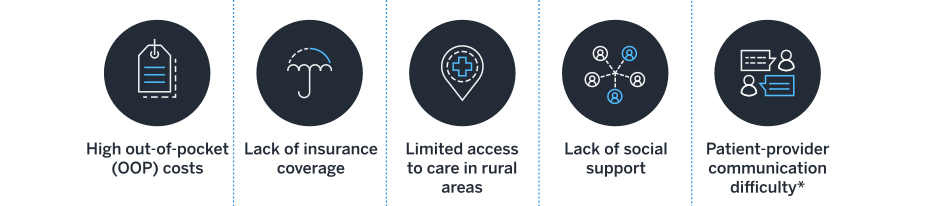
Source: Islami F., et al. (October 10, 2025). American Cancer Society's report on the status of cancer disparities in the United States, 2025. CA: A Cancer Journal for Clinicians. 76(1), e70045. Retrieved April 10, 2026, from https://acsjournals.onlinelibrary.wiley.com/doi/10.3322/caac.70045.
Many of these barriers are more likely to affect minority populations, further compounding disparities in care and outcomes.7
Life sciences companies can address these challenges through targeted, patient-centered support in partnership with stakeholders across the health system. These efforts may include:
- Supporting adaptive education and communication resources that improve patient understanding and support more effective engagement in care by considering diverse cultural values, beliefs, languages, and communication styles
- Providing translated materials and inclusive, patient-facing resources that help address language and health literacy barriers
- Strengthening care coordination roles by training nurse navigators or resourcing community health workers who can assist with insurance, referrals, and equitable access, while helping build patients’ trust through shared understanding and more frequent direct communication8
- Helping reduce logistical barriers to access by supporting programs and partnerships that improve transportation, telehealth access, low-cost screening access, financial assistance program access, or other practical supports for underserved populations9
- Partnering with advocacy and community organizations to expand awareness, strengthen local support groups/networks, and improve access to oncology care and treatment decision support
When implemented effectively, these coordinated efforts can help reduce avoidable barriers to care, improve engagement, and support more equitable oncology access and outcomes.
2. Precision medicine and diagnostics
Strengthening the path from testing to treatment
Biomarker and diagnostic testing are improving rapidly, but patients may not receive the right test and subsequent therapy at the right time. Biomarker testing, also referred to as “tumor testing” or “molecular profiling,” involves laboratory analyses of tumor tissue and/or blood to identify cancer‑specific biomarkers (e.g., gene alterations, protein expression patterns, or other molecular features).10 These data provide insight into tumor biology, support prediction of treatment response, and can help inform personalized treatment strategies like targeted therapies or immunotherapies.11
Delays and variability in biomarker and diagnostic testing impede timely, appropriate therapy selection. In one cohort, molecular profiling identified potentially actionable targets in 42% of patients, yet two-thirds did not receive matched therapy; among those who did, matched therapy was associated with approximately 2.6-fold longer overall survival.12 These findings suggest that the challenge is no longer only identifying actionable biomarkers, but ensuring that patients can access the right tests and then move from test result to appropriate therapy without unnecessary delays or barriers.
Advances in next-generation sequencing and liquid biopsies now enable comprehensive tumor profiling, but improving testing capabilities alone is not enough. To close the gap between test results and appropriate therapy, health systems require both scientific progress (e.g., more actionable targets, rapid and accurate phenotyping, innovative trial designs) and system-level work to standardize and integrate testing into routine care pathways and clinical workflows.13
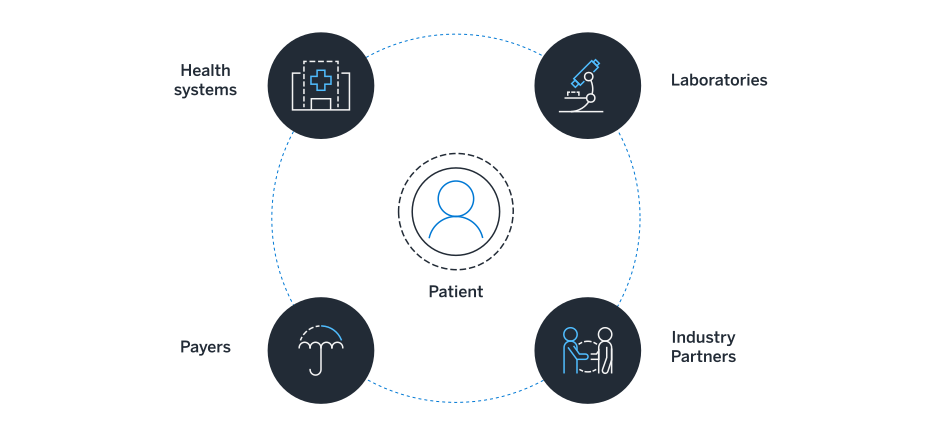
Addressing these gaps requires coordination across the care journey. Health systems, laboratories, payers, and industry partners all play a role in determining whether testing is ordered appropriately, results are returned on time, and those results are translated into comprehensive treatment decisions. Together, these stakeholders can identify barriers and codevelop practical solutions that reduce unwarranted variation in how testing is ordered, used, and acted upon.14
Figure 2: Coordination across the care journey
Life sciences companies can support health systems in this work by:
- Providing education on guideline-recommended testing and payer requirements to help support appropriate test utilization and reduce avoidable access friction
- Helping identify workflow barriers and variation points that may contribute to underuse, delays, or drop-off between testing and treatment
- Supplying practical tools and implementation resources that help health systems integrate testing more consistently into care pathways and clinical workflows
- Developing and disseminating evidence-based resources (such as case studies, tool kits, and best practices) codeveloped with clinical partners15
- Supporting more coordinated testing-to-treatment pathways by helping stakeholders align around practical approaches to ordering, turnaround, and interpretation
This collaborative approach can speed diagnostic innovation and provide a scalable model for advancing personalized medicine. When these efforts are embedded thoughtfully into care pathways and clinical workflows, they can help reduce delays, improve consistency across sites of care, and increase the likelihood that patients receive biomarker-guided care when it matters most.16
3. Therapy continuity and patient support
Supporting therapy continuity across the oncology journey
Even when patients are prescribed appropriate oncology therapies, successful treatment still depends on their ability to start, stay on, and safely navigate care over time. In practice, that process can be difficult. Cancer treatment often involves complex treatments with high out-of-pocket (OOP) costs, multiple care transitions, side effect management, and coordination across providers and settings, all of which can increase the likelihood of errors and create barriers to adherence, persistence, and continuity of care.17,18These challenges can have meaningful clinical consequences. In a retrospective cohort of 37,938 patients with cancer, only 51.9% were adherent to oral anticancer medications (OAMs), with several studies reporting higher OOP costs for OAMs to be a significant predictor of nonadherence.19,20,21 More broadly, nonadherence and treatment disruption can contribute to unfavorable clinical outcomes, increased morbidity and mortality, and missed opportunities to realize the full benefit of therapy.22
Improving therapy continuity requires a clearer understanding of where patients are encountering barriers or discontinuity across the treatment pathway and what types of support are most effective at each stage. Health systems can use metrics such as adherence, persistence, and time to first fill to identify points of drop-off, monitor patterns over time, and target interventions more effectively.
Therapy continuity, however, is shaped by more than medication-taking behavior alone. Patients may struggle to remain on treatment when physical symptoms, psychosocial distress, nutritional challenges, or treatment-related comorbidities are not identified and addressed early. For that reason, holistic supportive care, a comprehensive healthcare approach that treats the whole person (body, mind, and spirit) rather than just symptoms and diseases, should be viewed as a core component of treatment continuity rather than a parallel or downstream service. The National Comprehensive Cancer Network (NCCN) and the American Society of Clinical Oncology (ASCO) increasingly support proactive integration of psychosocial distress screening, nutrition screening, symptom management, physical activity (when appropriate), and early subspecialty involvement (when treatment may introduce further risks or comorbidities) into routine oncology care.23,24
The evidence supporting these interventions continues to grow. Across several cancer types, exercise has been shown to reduce fatigue and improve cardiorespiratory fitness, muscle strength, and physical function during treatment.25 Nutrition is equally essential.26 Treatment-related symptoms commonly impair nutritional status, which can in turn adversely affect clinical, psychosocial, and patient-reported outcomes.27 Evidence-based nutrition care is therefore a core element of patient-centered care.28 And despite the prevalence of psychological symptoms during treatment, they often remain under-recognized and undertreated, sometimes trivialized as an expected patient reaction.29
Life sciences companies can help health systems strengthen therapy continuity and holistic supportive care delivery by supporting practical, patient-centered interventions across the treatment journey. In collaboration with third parties and through compliant, non-promotional approaches, these efforts may include:
- Providing educational resources for patients and providers on treatment expectations, side effect management, and the importance of staying engaged in care
- Supplying data-informed insights that help health systems understand national benchmarks, common drop-off points, and opportunities to better target support interventions related to therapy management and nonadherence
- Supporting practical tools and workflow resources that help integrate distress screening, nutrition support, symptom management, subspecialty referral, and patient education into routine oncology care
- Developing implementation resources such as evidence-based tool kits, workflow models, case studies, and staff education materials that help operationalize more consistent supportive care and therapy support
- Helping reduce avoidable barriers to continuity by enabling programs and resources that improve care coordination and support patients across transitions in care
When implemented effectively, these efforts can help patients stay engaged in care and improve the likelihood that therapy delivers its intended benefit.
How life sciences companies can help build a path toward improved oncology patient outcomes
Life sciences organizations and health systems can work together to improve oncology patient outcomes by reducing barriers across the care journey, from addressing health equity gaps and improving biomarker-guided treatment selection to strengthening therapy continuity and embedding holistic supportive care.
These challenges are not isolated but interconnected drivers of whether patients receive timely, evidence-based, and sustainable care in real-world settings. When these gaps are addressed thoughtfully, it can help improve consistency across sites of care, reduce avoidable disruption in care delivery, and create a stronger foundation for better patient outcomes and experiences.
For life sciences companies, this creates an opportunity to contribute beyond the product itself through cocreation of relevant resources with health systems and other stakeholders. Together, they can help fund, develop, and operationalize the resources, evidence, and support models needed to strengthen care delivery in practical, compliant, and patient-centered ways. In our experience, the organizations best positioned to make progress in this space are those that pair scientific innovation with effective implementation, bringing together evidence, workflows, and patient support in ways that are built for real-world use.
1 Siegel, R.L., Jemal, A., Wender, R.C., Gansler, T., Ma, J., & Brawley, O.W. (July 10, 2018). An assessment of progress in cancer control. CA: A Cancer Journal for Clinicians, 68(5), 329–339. Retrieved May 15, 2026, from https://doi.org/10.3322/caac.21460.
3 Ndugga, N., Pillai, D., & Artiga, S. (August 14, 2024). Disparities in health and health care: 5 key questions and answers. KFF. Retrieved May 15, 2026, from https://www.kff.org/racial-equity-and-health-policy/disparities-in-health-and-health-care-5-key-question-and-answers/.
4 Siegel, R.L., Jemal, A., Wender, R.C., Gansler, T., Ma, J., & Brawley, O.W. (July 10, 2018). An assessment of progress in cancer control. CA: A Cancer Journal for Clinicians, 68(5), 329–339. Retrieved May 15, 2026, from https://doi.org/10.3322/caac.21460.
5 Islami F., et al. (October 10, 2025). American Cancer Society's report on the status of cancer disparities in the United States, 2025. CA: A Cancer Journal for Clinicians. 76(1), e70045. Retrieved April 10, 2026, from https://acsjournals.onlinelibrary.wiley.com/doi/10.3322/caac.70045.
6 Hendren, S., Chin, N., Fisher, S., Winters, P., Griggs, J., Mohile, S., & Fiscella, K. (July 2011). Patients' barriers to receipt of cancer care, and factors associated with needing more assistance from a patient navigator. Journal of the American Medical Association, 103(8), 701–710. Retrieved April 10, 2026, from https://doi.org/10.1016/s0027-9684(15)30409-0.
10 National Cancer Institute. (December 14, 2021). Biomarker testing for cancer treatment. Retrieved May 15, 2026, from https://www.cancer.gov/about-cancer/treatment/types/biomarker-testing-cancer-treatment.
12 Mapendano, C.K., et al. (January 2025). Longer survival with precision medicine in late-stage cancer patients. ESMO Open, 10(1), 104089. Retrieved May 15, 2026, from https://doi.org/10.1016/j.esmoop.2024.104089.
13 Rulten, S.L., Grose, R.P., Gatz, S.A., Jones, J.L., & Cameron, A.J.M. (August 9, 2023). The future of precision oncology. International Journal of Molecular Sciences, 24(16),12613. Retrieved May 15, 2026, from https://doi.org/10.3390/ijms241612613. .
14 Lennerz, J.K., Farfsing, A., Kiehl, T.R., Perner, S., van Duuren, J., Christ, M., & Farfsing, J.W. (August 2025). Enhancing diagnostic innovation by leveraging the co-creation approach. Journal of Pathology Informatics, 18, 100460. Retrieved May 17, 2026, from https://doi.org/10.1016/j.jpi.2025.100460.
17 Komatsu, H., Hara, A., Koyama, F., & Komatsu, Y. (January 31, 2025). Enhancing high reliability in oncology care: The critical role of nurses—A systematic review and thematic analysis. Healthcare, 13(3), 283. Retrieved May 17, 2026, from https://doi.org/10.3390/healthcare13030283.
18 V, R., Chacko, A.M., Abdulla, N., Annamalai, M., & Kandi, V. (January 22, 2024). Medication adherence in cancer patients: A comprehensive review. Cureus, 16(1), e52721. Retrieved May 17, 2026, from https://doi.org/10.7759/cureus.52721.
19 Vyas, A., Descoteaux, A., Kogut, S., Parikh, M.A., Campbell, P.J., Green, A., & Westrich, K. (July 25, 2022). Predictors of adherence to oral anticancer medications: An analysis of 2010–2018 US nationwide claims. Journal of Managed Care & Specialty Pharmacy, 28(8), 831–844. Retrieved May 17, 2026, from https://doi.org/10.18553/jmcp.2022.28.8.831.
20 Shen, C., Zhao, B., Liu, L., & Shih, Y.T. (January 15, 2018). Adherence to tyrosine kinase inhibitors among Medicare Part D beneficiaries with chronic myeloid leukemia. Cancer, 124(2), 364–373. Retrieved May 17, 2026, from https://doi.org/10.1002/cncr.31050.
21 Goulart, B.H.L., Unger, J.M., Chennupati, S., Fedorenko, C.R., & Ramsey, S.D. (2021). Out-of-pocket costs for tyrosine kinase inhibitors and patient outcomes in EGFR- and ALK-positive advanced non-small-cell lung cancer. JCO Oncology Practice, 17(2), e130–139. Retrieved May 17, 2026, from https://doi.org/10.1200/OP.20.00692.
22 V, R., Chacko, A.M., Abdulla, N., Annamalai, M., & Kandi, V. (January 22, 2024). Medication adherence in cancer patients: A comprehensive review. Cureus, 16(1), e52721. Retrieved May 17, 2026, from https://doi.org/10.7759/cureus.52721.
23 Bergerot, C.D., et al. (November 7, 2024). Enhancing cancer supportive care: Integrating psychosocial support, nutrition, and physical activity using telehealth solutions. JCO Global Oncology, 10, e2400333. Retrieved May 17, 2026, from https://doi.org/10.1200/GO-24-00333.
24 Leong, D.P., Guha, A., Morgans, A.K., Niazi, T., & Pinthus, J. H. (November 19, 2024). Cardiovascular risk in prostate cancer: JACC: CardioOncology state-of-the-art review. JACC: CardioOncology, 6(6), 835–846. Retrieved May 17, 2026, from https://doi.org/10.1016/j.jaccao.2024.09.012.
26 Erickson, N., et al. (February 2025). Nutrition care in cancer: An overlooked part of patient centered care. Seminars in Oncology Nursing, 41(1), 151799. Retrieved May 17, 2026, from https://doi.org/10.1016/j.soncn.2shown to reduce fatigue and improve cardiorespiratory fitness, muscle strength, and physical function during treatment024.151799.
27 Rock, C.L., et al. (March 16, 2022). American Cancer Society nutrition and physical activity guideline for cancer survivors. CA: A Cancer Journal for Clinicians, 72(3), 230–262. Retrieved May 17, 2026, from https://doi.org/10.3322/caac.21719.
28 Erickson, N., et al. (February 2025). Nutrition care in cancer: An overlooked part of patient centered care. Seminars in Oncology Nursing, 41(1), 151799. Retrieved May 17, 2026, from https://doi.org/10.1016/j.soncn.2024.151799.
29 Andersen, B., et al. (April 19, 2023). Management of anxiety and depression in adult survivors of cancer: ASCO guideline update. Journal of Clinical Oncology, 41, 3426–3453. Retrieved May 17, 2026, from https://doi.org/10.1200/JCO.23.00293.