山火事リスクが高まり続ける中、地域社会、消防機関、政策立案者は、火災による財産損失の可能性を減らすための戦略にこれまで以上に重点を置いています。耐火住宅や防火対策といった概念は、リスク評価と予防の取り組みの主役になってきています。防御空間とは、山火事リスクを下げ、自分たちの住まいを守るために、地域社会が直ちに実効的行動を取れる重要区域として認識されています。
ゾーン・ゼロとは?
ゾーン・ゼロ(Zone Zero)とは、建物から0~5フィート(約0~1.5m 範囲の防御可能な空間を指し、山火事対策に最も重要な区域です1。防御可能な空間とは、火の気の行方に影響を与え、財産を守るために管理できる、住宅の周囲100フィート(約30m)の緩衝区域を指します。この緩衝区域は通常、次の3つのゾーンに区分されます。
- ゾーン・ゼロ(0〜5フィート):適切に建物が耐火対策されている場合、「隣接ゾーン(Immediate Zone)」または「飛び火対策ゾーン(Ember-Resistant Zone)」とも呼ばれます
- ゾーン1(5〜30フィート)
- ゾーン2(30〜100フィート)
調査研究(事例1、事例2)2、3 によると、ゾーン・ゼロは、飛び火によって広がる山火事で、最も脆弱な区域であることが示されています。特にゾーン・ゼロで、植生や可燃物を取り除くことで、住宅に着火するリスクを大幅に低減することが可能です(事例1、事例2)。4、5
As the risk of wildfires continues to rise, communities, fire agencies, and policymakers are placing additional emphasis on strategies to reduce potential property losses. Concepts such as home hardening and fire mitigation are now central to risk assessment and prevention efforts. Defensible space is being recognized as a critical area where communities can take immediate, effective action to lower wildfire risk and protect their homes.
What is Zone Zero?
Zone Zero refers to the defensible space within 0–5 feet of a structure—the area most critical for wildfire protection.1 Defensible space is the 100-foot buffer around a home that can be managed to influence fire behavior and protect property. This buffer is typically divided into three zones:
- Zone Zero (0–5 feet), also called the Immediate Zone or Ember-Resistant Zone when properly hardened
- Zone 1 (5–30 feet)
- Zone 2 (30–100 feet)
Research (Example 1, Example 2)2,3 has shown that Zone Zero is the area most vulnerable to ignition during ember-driven wildfires. By removing vegetation and combustible materials—especially in Zone Zero—homeowners can dramatically reduce the risk of structure ignition (Example 1, Example 2).4,5
Figure 1: Defensible space around a structure subdivided into Zones Zero, 1, and 2
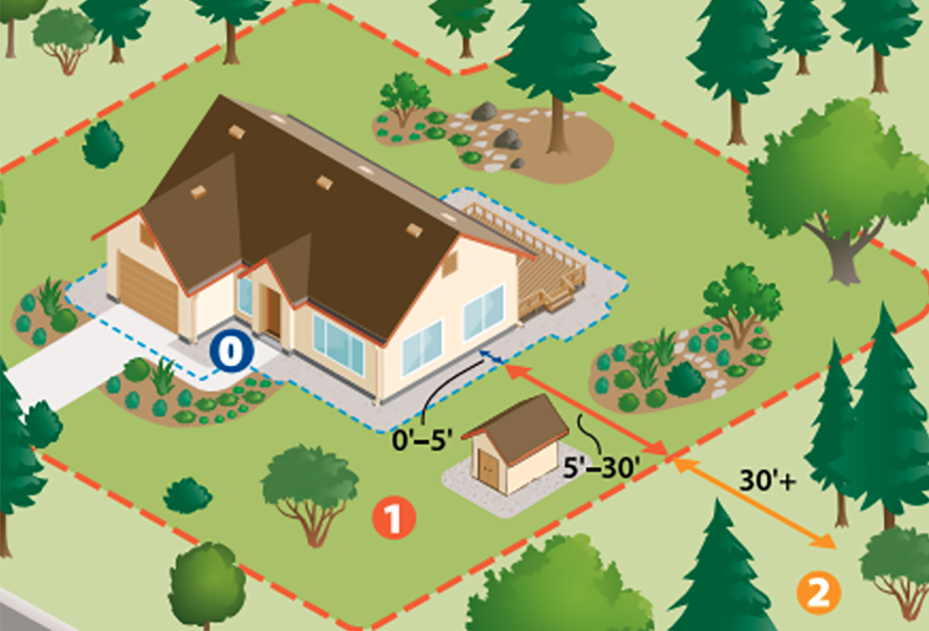
Source: Moraga-Onida Fire District. (n.d.). Reducing the Risk of Wildfire in our Community: Essential Actions for Implementing Zone Zero and Fire Hazard Severity Zones. Retrieved March 10, 2026, from https://www.mofd.org/our-district/fuels-mitigation-fire-prevention/zone-zero-and-fire-hazard-severity-zone.
Why is Zone Zero important for wildfire mitigation?
Structures can ignite in three main ways:
- Radiant heat – Intense heat from nearby flames ignites the structure.
- Direct flame contact – Flames from burning fuel directly touch and ignite the structure.
- Ember ignition – Wind-driven embers can rapidly travel distances of over 2 miles and ignite any burnable surface they land on.
Ember ignition is the most common cause of home loss during wildfires because the most destructive wildfires are typically accompanied by high winds that carry embers long distances quickly. Removing fuels, such as vegetation, wooden fences, and debris, from Zone Zero reduces the likelihood of all types of ignition. The type of vegetation or material is less important than its combustibility: Once that material ignites, it becomes fuel for a fire (Example 1, Example 2).6,7 According to a December 2025 study from the Insurance Institute for Business and Home Safety (IBHS), plants in Zone Zero with higher moisture content can take longer to ignite.8 However, during the time it takes for the plant to ignite, the nearby structure is preheating, which makes it more likely to ignite when the vegetation does ignite.
Wildfires pose a unique risk to communities because of the threat of urban conflagration—when fire spreads rapidly through neighborhoods. Homes, fences, and other structures can act as fuel, allowing fire to leap from building to building. For example, a wooden fence connecting several homes can act as a wick, rapidly spreading fire across properties. Creating fuel breaks and removing combustibles, especially in Zone Zero, help prevent this chain reaction.
While no fire mitigation strategy is guaranteed, a recent study published in Nature estimates that community-level mitigation measures in tandem with hardened homes could reduce wildfire losses over 50% in the WUI.9 Furthermore, removing fuels from Zone Zero could give firefighters critical time to respond and protect homes and lives.
Zone Zero regulations in California
California faces high wildfire risk and extensive community growth in the wildland-urban interface (WUI) with more than 11 million people living in the WUI today.10 In 2020, California passed Assembly Bill 3074, which directed the Board of Forestry and Fire Protection to establish regulations for an ember-resistant zone within 5 feet of a structure.11 In February 2025, Governor Newsom issued Executive Order N-18-25 to accelerate the rulemaking process for these regulations.12
Regulations are still under development for several reasons, including evolving scientific understanding, the need for incremental policy change, and homeowner consideration during rollout. However, according to the California Department of Forestry and Fire Protection (CAL FIRE),13 key considerations for maintaining an ember-resistant Zone Zero include:
- Clear dead vegetation from outdoor areas, including roofs and gutters; trim branches to be 10 feet away from chimneys and stovepipes.
- Replace combustible materials, such as flammable mulch, with nonflammable alternatives, such as gravel, pavers, or concrete.
- Store items such as garbage and recycling containers, vehicles, boats, and RVs outside of Zone Zero.
See this Zone Zero checklist and wildfire risk to communities guide for more information.
What’s next?
While maintaining an ember-resistant Zone Zero provides individual homes with better protection, the greatest impact is achieved when entire communities adopt these practices. As regulations evolve and awareness grows, coordinated efforts among homeowners, local governments, and fire agencies will be critical to reducing wildfire risk on a larger scale.
There are relatively low-cost, high-impact steps that can be taken now if you live in a fire hazard severity zone. Clearing debris, pruning vegetation, and moving flammable items away from the home are key examples. Codifying these requirements will ensure that communities support one another by taking simple actions to reduce wildfire risk for all.
Ultimately, collective action is key. By working together to prioritize an ember-resistant Zone Zero, communities can safeguard lives and property, support firefighters’ efforts, and build long-term resilience against the growing threat of wildfires.
Zone Zero Assembly Bill California Executive Order14
- Homeowners with property within the State Responsibility Area (SRA) or Very High Fire Hazard Severity Zone in the Local Responsibility Area (LRA) must maintain defensible space up to 100 feet from the structure (within property lines, unless otherwise required), per Public Resource Code § 4291 and Government Code § 51182, respectively.15,16
- Fuels in defensible space must be "maintained and spaced in a condition so that a wildfire would be unlikely to ignite the structure."
- The intensity of fuels management may vary within the 100 feet based on regulations by the Board of Forestry. Zones 1 and 2 requirements were implemented in Title 14 California Code of Regulations § 1299.03.17
- The most intense fuel management is currently being considered for Zone Zero, establishing it as an ember-resistant zone.
Further reading
- Defensible space zones (Board of Forestry and Fire Protection)
- How to create defensible space for wildfire safety (California Department of Forestry and Fire Protection)
- Home ignition zone explained (Western Fire Chiefs Association)
- Understanding California’s “Zone Zero” regulations: What homeowners need to know (MySafe:LA)
1 California Department of Forestry and Fire Protection. (n.d.). Zone 0 at-a-glance. Retrieved March 11, 2026, from https://34c031f8-c9fd-4018-8c5a-4159cdff6b0d-cdn-endpoint.azureedge.net/-/media/calfire-website/prepare/zone-0-at-a-glance.pdf?rev=e69dfc1303de4f5eb2542a2fee69ce4b&hash=BCDEB96560E2F66E2D2893CE98777519.
2 Cohen, J. D. (2000). Preventing disaster: Home ignitability in the wildland-urban interface. Journal of Forestry, 98(3), 15–21. Retrieved March 11, 2026, from https://www.fs.usda.gov/rm/pubs_other/rmrs_2000_cohen_j002.pdf.
3 Syphard, A. D., Brennan, T. J., & Keeley, J. E. (2014). The role of defensible space for residential structure protection during wildfires. International Journal of Wildland Fire, 23(8), 1165–1175. Retrieved March 11, 2026, from https://pubs.usgs.gov/publication/70141773.
4 Monroy, X., Sluder, E., Hedayati, F., Pogorzelski, H., & Morrison, M. (December 2025). The 2025 LA Conflagrations. Insurance Institute for Business and Home Safety. Retrieved March 11, 2026, from https://ibhs1.wpenginepowered.com/wp-content/uploads/FINAL-compressed-The-2025-LA-Conflagrations-IBHS.pdf.
5 Zamanialaei, M., et al. (2025). Fire risk to structures in California’s Wildland-Urban Interface. Nature Communications, 16, 8041. Retrieved March 11, 2026, from https://www.nature.com/articles/s41467-025-63386-2.
6 Ager, A. A., Vaillant, N. M., & Finney, M. A. (2010). A comparison of landscape fuel treatment strategies to mitigate wildland fire risk in the urban interface and preserve old forest structure. Forest Ecology and Management, 260(1), 166–167. Retrieved March 11, 2026, from https://www.fs.usda.gov/pnw/pubs/journals/pnw_2010_ager001.pdf.
7 Hakes, R. S. P., Caton, S. E., Gorham, D. J., & Gollner, M. J. (2016). A review of pathways for building fire spread in the wildland urban interface part II: Response of components and systems and mitigation strategies in the United States. Fire Technology, 53, 475–515. Retrieved March 11, 2026, from https://link.springer.com/article/10.1007/s10694-016-0601-7.
8 Insurance Institute for Business and Home Safety. (December 2025). Vegetation in Zone 0: Amplifying damage to structures. Retrieved March 11, 2026, from https://ibhs1.wpenginepowered.com/wp-content/uploads/Vegetation-in-Zone-0-Amplyfying-Damage-to-Structures.pdf.
9 Zamanialaei, M. et al. (August 2025). Fire risk to structures in California’s Wildland-Urban Interface. Retrieved March 30, 2026 from https://www.nature.com/articles/s41467-025-63386-2#Sec6.
10 Radeloff, V. C., et al. (2018). Rapid growth of the U.S. wildland-urban interface raises wildfire risk. Proceedings of the National Academy of Sciences, 115(13), 3314–3319. Retrieved March 11, 2026, from https://www.pnas.org/doi/abs/10.1073/pnas.1718850115.
11 The full text of Assembly Bill 3074 is available at https://leginfo.legislature.ca.gov/faces/billNavClient.xhtml?bill_id=201920200AB3074.
12 The full text of Executive Order N-18-25 is available at https://www.gov.ca.gov/wp-content/uploads/2025/02/EO-_Urban-Conflagration-N-18-25-Final.pdf.
13 California Department of Forestry and Fire Protection. (n.d.). Defensible space. Retrieved March 11, 2026, from https://www.readyforwildfire.org/prepare-for-wildfire/defensible-space.
14 Fire prevention: wildfire risk: defensible space: ember-resistant zones, A.B. 3074, 2019–2020 Reg. Sess. (Cal. 2020). Retrieved March 11, 2026, from https://leginfo.legislature.ca.gov/faces/billTextClient.xhtml?bill_id=201920200AB3074.
15 Cal. Pub. Res. Code § 4291. (2005). Retrieved March 11, 2026, from https://leginfo.legislature.ca.gov/faces/codes_displayText.xhtml?lawCode=PRC&division=4.&title&part=2.&chapter=3.&article.
16 Cal. Gov. Code § 51182. (2005). Retrieved March 11, 2026, from https://leginfo.legislature.ca.gov/faces/codes_displaySection.xhtml?lawCode=GOV§ionNum=51182.
17 Cal. Code. Reg. Title 14 § 1299.03. (2013). Retrieved March 11, 2026, from https://calfire-umb05.azurewebsites.net/media/9298/fpc-4-aug-2019-wlpz-timber-ops-re-conversion-exs-ada.pdf.